


Every few weeks someone emails me a screenshot of a funded account and asks whether it’s real. The honest answer is more interesting than either side of the argument usually admits.
Here is the short version. In most funded trading programs, the account you trade after passing the evaluation is still a simulated account. The payouts are real money, but they come out of the company’s revenue rather than out of profits your orders generated in the market. The published pass rates are low, and when you model them properly, those rates tell you something specific about who is buying: not that the rules are impossible, but that the average buyer is starting from a small negative edge and paying for the privilege of finding out slowly.
That distinction matters, because the two conclusions lead to completely different responses. If the rules are rigged, you look for a fairer firm. If the edge is missing, no firm will fix it.
What you are actually buying
A funded trading program sells an evaluation. You pay a fee, usually somewhere between fifty and a thousand dollars depending on the notional account size. You trade a simulated account under a set of rules. If you satisfy the rules, your account status changes to “funded” and you become eligible to request a share of any further simulated profits.
Read that sequence again, because the product is the evaluation. Not capital. Not a job. Not a seat. The evaluation is the thing being sold, and everything downstream of it is a conditional status rather than an asset you own.
This is not hidden. It is generally written into the terms and conditions, often in plain language, and the better operators say it clearly on the page. What has changed over the last few years is the vocabulary around it. A number of firms now describe themselves as educational or simulation platforms rather than trading firms, which is a more accurate description of what they do and also a more comfortable position to hold while regulators work out where the model sits.
Does the money become real when you pass?
Sometimes. Not usually in the way the marketing implies.
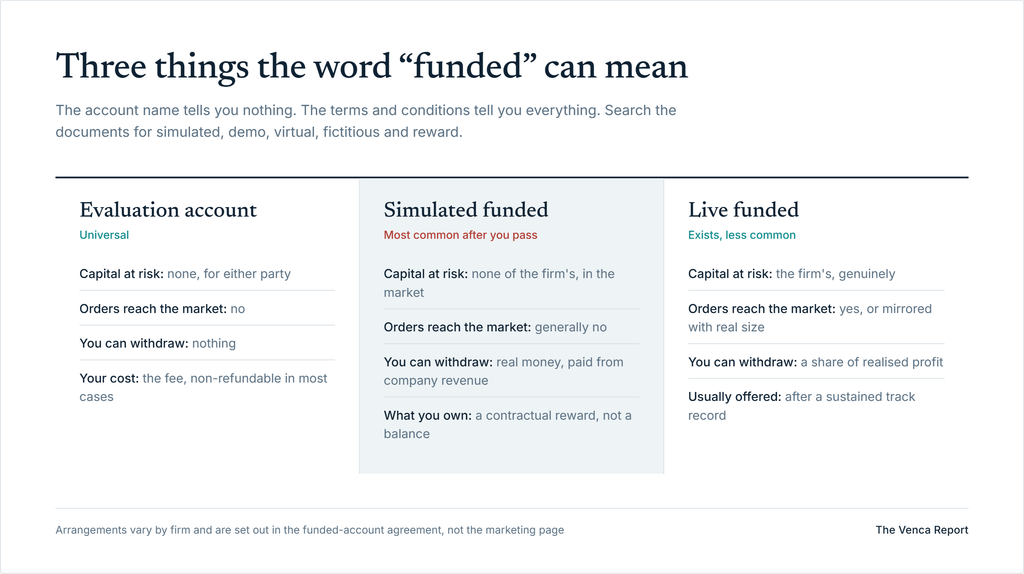
There are three arrangements in circulation, and firms use different combinations of them:
Simulated evaluation.
Effectively everybody does this. No capital is at risk while you are being assessed, which is reasonable. Nobody hands money to an unproven stranger.
Simulated funded account.
You pass, the balance goes up, the rules continue, and your orders still do not reach a live market. Any payout is a contractual reward calculated from simulated performance and paid from company funds. This is the most common post-evaluation arrangement in the retail sector.
Live funded account.
Your orders are routed to a real market, or your flow is mirrored by the firm with its own capital behind it. This exists. It is less common, and it is usually reserved for traders who have already demonstrated results over a meaningful period.
The practical test is not what the dashboard says. It is what the documents say. Search the terms and conditions for the words simulated, demo, virtual, fictitious, and reward. If the agreement tells you the funds are notional and the trading is not real market trading, that is your answer regardless of what the account is called.
None of this is automatically dishonest. A firm can run a simulated book, pay every valid request in full, and be a perfectly straight business. But a firm that will not state plainly where the payout money comes from has told you something, and you should hear it.
How the model makes money
Three revenue lines, in rough order of size for most operators.
Evaluation fees are the primary one. This is the business. Evaluation fees are the primary one. This is the business. Millions of challenge purchases a year at a couple of hundred dollars each is a large, predictable, prepaid revenue stream with no market risk attached to it.
Resets and retries are the second. A failed evaluation is not a lost customer. It is a customer with a reason to buy again, usually at a discount, usually within days, usually convinced they were unlucky rather than unprofitable. This is the most valuable customer relationship in the industry and it is entirely a function of near misses.
Affiliate and referral spend is the third, running in the other direction. A meaningful share of fee revenue goes straight back out to the people promoting the challenges. When you see a trading account screenshot with a discount code underneath it, you are looking at a customer acquisition cost, not a track record.
Payouts sit against all of that as a cost line. A firm’s job, commercially, is to set rules loose enough that people believe the target is reachable and tight enough that the payout line stays smaller than the fee line. That is a product design problem, and it is a solvable one.
The criteria, and why they look harder than they are
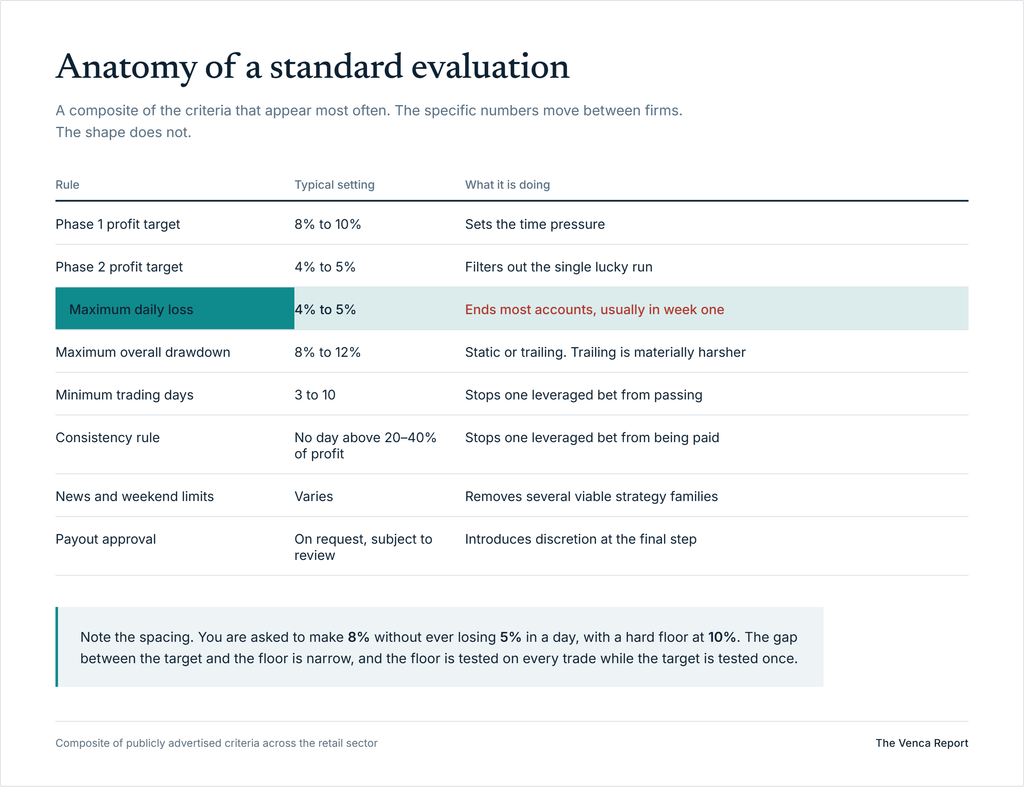
Here is a composite of the criteria that appear most often. I have not named a firm because the specific numbers move around; the shape does not.
| Rule | Typical setting | What it is really doing |
|---|---|---|
| Phase 1 profit target | 8% to 10% | Sets the time pressure |
| Phase 2 profit target | 4% to 5% | Filters out the one lucky run |
| Maximum daily loss | 4% to 5% | The rule that actually ends most accounts |
| Maximum overall drawdown | 8% to 12% | Static or trailing; trailing is far harsher |
| Minimum trading days | 3 to 10 | Prevents a single leveraged bet from passing |
| Consistency rule | No day above 20% to 40% of total profit | Prevents a single leveraged bet from paying |
| News and weekend restrictions | Varies | Removes several viable strategy families |
| Payout schedule | Every 14 to 30 days, on request | Introduces discretion into the final step |
Look at the interaction between the first two rows and the third. You are asked to make eight percent while never losing five percent in a day, with your maximum permitted loss set only slightly above your required gain. There is very little room between the target and the floor, and the floor is checked more often than the target.
Industry trackers estimate that most failed evaluations end on a drawdown breach rather than on running out of time short of the target, and that a large share of those breaches happen in the first week. That is not a story about people who could not reach eight percent. It is a story about people who never got far enough to try.
I simulated a million evaluations. The result was not what I expected.
I wanted to know whether a trader with a real, modest, well-managed edge can pass a standard two-phase evaluation. So I built it and ran it.
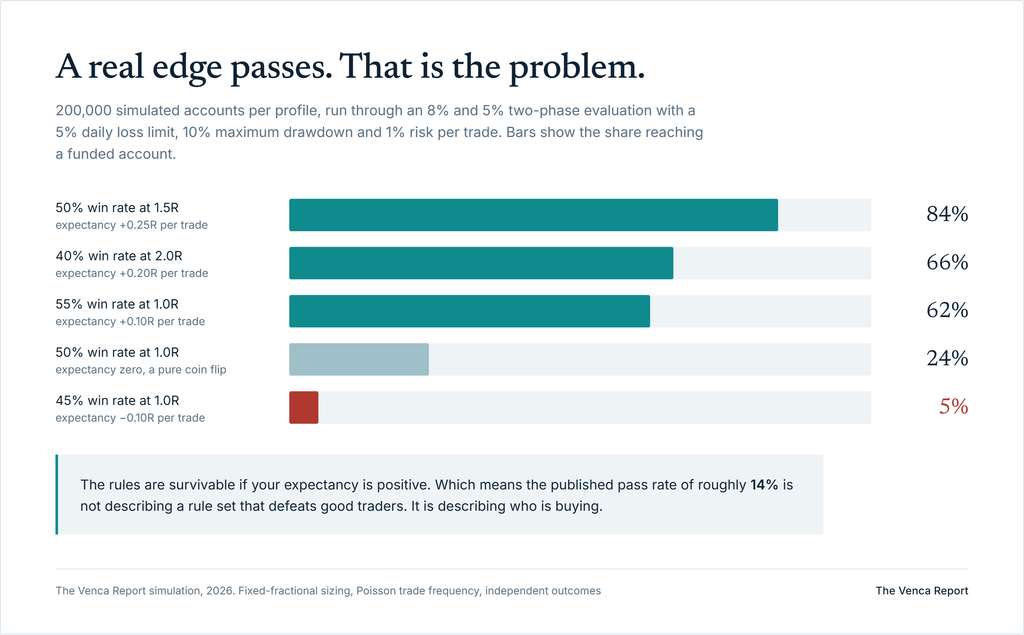
The setup: an 8% phase one target and a 5% phase two target, a 5% daily loss limit, a 10% overall drawdown limit measured against the starting balance, a thirty-day phase one window, an average of three trades a day, and fixed risk of one percent of the account per trade. Every trade is either a full loss or a win at the stated payoff. No partials, no correlation, no discretion. It is a deliberately simple model and the assumptions are all listed so you can disagree with them.
The results, as a percentage of accounts that started:
| Trader profile | Expectancy per trade | Passed phase 1 | Reached funded | Reached a first payout |
|---|---|---|---|---|
| 50% win rate at 1.5R | +0.25R | 89% | 84% | 78% |
| 40% win rate at 2.0R | +0.20R | 78% | 66% | 56% |
| 55% win rate at 1.0R | +0.10R | 70% | 62% | 54% |
| 50% win rate at 1.0R | 0.00R | 39% | 24% | 15% |
| 45% win rate at 1.0R | −0.10R | 14% | 5% | 1.5% |
The first three rows are the finding. A trader with a genuine edge and disciplined position sizing passes a standard evaluation most of the time. The rules are not the obstacle. They are conservative, they are annoying, and they are broadly survivable if your expectancy is positive and your risk per trade is sensible.
Which raises the obvious question. If a real edge passes comfortably, why do the published numbers look the way they do?
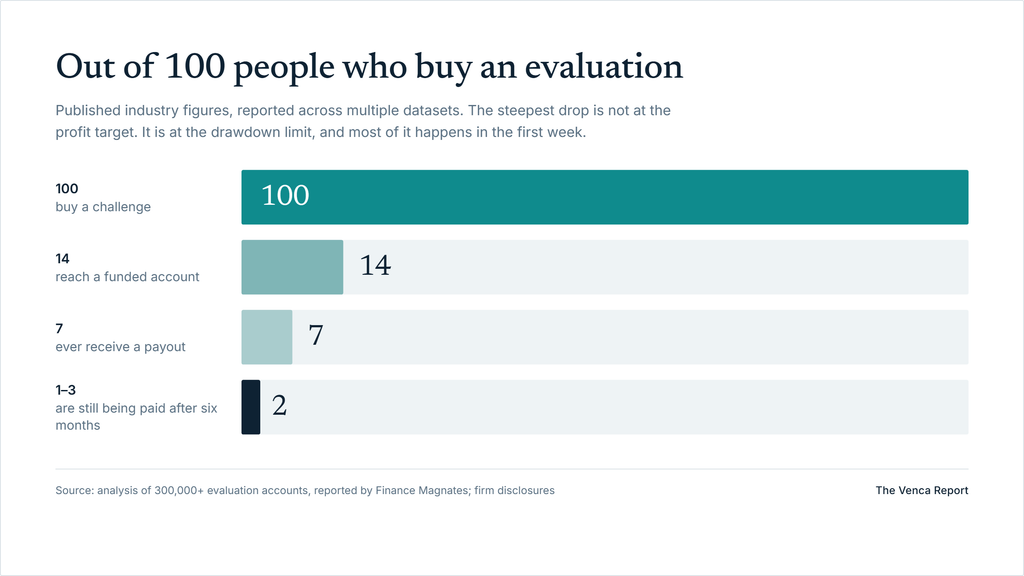
The most-cited independent dataset, an analysis of more than 300,000 accounts across multiple firms reported by Finance Magnates, found roughly 14% of buyers reached a funded account and around 45% of those ever received a payout, putting about 7% of all buyers in the paid column. Long-term consistently paid traders sit somewhere in the range of one to three percent. Firms that publish their own numbers tend to report pass rates between five and ten percent.
So I ran the model backwards. Instead of assuming a trader profile, I solved for the profile that reproduces the published funnel.
| Simulated trader | Expectancy | Reached funded | Ever paid |
|---|---|---|---|
| 46% win rate at 1:1 | −0.08R | 6.6% | 2.6% |
| 47% win rate at 1:1 | −0.06R | 9.7% | 4.3% |
| 48% win rate at 1:1 | −0.04R | 13.6% | 6.9% |
| 49% win rate at 1:1 | −0.02R | 18.4% | 10.5% |
| 50% win rate at 1:1 | 0.00R | 24.5% | 15.7% |
A 48% win rate at one-to-one, an expectancy of minus four hundredths of a risk unit per trade, reproduces the industry’s published funnel almost exactly. Not a catastrophic trader. Not a gambler. Someone who is very slightly behind, which is what a coin flip becomes once you subtract the spread and the commission.
That is the actual mechanism, and it is more uncomfortable than the rigged-rules version.
The model does not need to cheat. It needs a customer base whose expectancy is slightly negative, a rule set tight enough that slightly negative compounds into a breach, and a price point low enough that failing feels like bad luck rather than information. Randomness does the rest. Note the fourth row of the first table: a trader with no edge at all still clears phase one 39% of the time. Enough people pass by chance to keep the testimonials coming, and of every hundred who start, fifteen ever collect anything.
This is why I am not persuaded by the search for a fairer program. If your expectancy is minus 0.04R, a firm with a 12% target instead of 8% changes your outcome by a rounding error. The constraint is not the rule set. It is the four hundredths.
The rules that quietly cap the upside
Assume you pass, and assume you are one of the traders with a real edge. Several clauses still sit between you and the money, and they are worth reading before you pay rather than after.
The consistency rule is the most consequential. If no single day may account for more than, say, 25% of your total profit, then any strategy that makes its money in concentrated bursts is disqualified by construction. Event-driven trading, breakout trading, and most macro-driven approaches produce exactly that profit shape. The rule is defensible as risk management and it is also, conveniently, a cap on the firm’s largest payouts.
News restrictions do similar work. A prohibition on holding through scheduled data removes the moments when macro-informed positioning actually pays.
Then there is payout discretion. Look for the clause that allows the firm to review, delay, or deny a request where it suspects the rules were not followed in spirit. Some version of this exists nearly everywhere, and it is where the disputes live.
The layer around it that nobody regulates
There is a second industry attached to the first, and it is the part I find harder to defend.
Selling a challenge is at least a transaction with defined terms. Selling a course that promises a repeatable method for passing challenges is a different thing. In most jurisdictions, general educational content sits outside the financial advice perimeter, which means the person selling it needs no license, no qualification, no track record, and no obligation to tell you how they actually make their money.
Ask three questions before you buy anything in this category. What did this person do in markets before they started selling, and can it be verified. Where does their income come from today, teaching or trading. And is the material describing what moves price, or is it describing a set of rules for entering trades.
It is also worth doing the arithmetic on the second question. Running a content business is expensive in hours. Filming, editing, posting, funnels, ads, affiliates, support. Nobody with a reliable, scalable edge chooses that workload over the alternative, because the alternative is quieter and pays better. When someone with genuine market experience moves into education full time, the honest reading is usually that the teaching income is more dependable than the trading income was, which is a legitimate business decision but also a piece of information about the trading.
The tell is the reciprocal. Somebody who genuinely wants to pay it forward can publish for free. Somebody who is running a business has a funnel. Both are fine. Only one of them should be described as the first.
What professional trading actually looks like
The gap between the marketing and the reality is not mainly about win rates. It is about scale and time.
A good discretionary macro book might target something in the region of eight to fifteen percent a year, with drawdowns of ten to twenty percent along the way and a Sharpe ratio somewhere near one. Sustained Sharpe above two is exceptional and rarely lasts. Losing months are routine; a losing year is unremarkable and career-ending only if it is repeated.
Now apply that to a retail account. Fifteen percent on twenty-five thousand dollars is three thousand seven hundred and fifty dollars before tax, in a good year. That is the real number, and it is why professional trading is done with either institutional capital or a large personal balance sheet. The skill compounds; the returns only compound if there is something to compound.
This is the part the funded account model exists to paper over. It offers the return profile of a large account without requiring the large account, and it does it by replacing capital risk with rule risk. You are no longer trading against the market. You are trading against a set of thresholds, on a clock, with an intraday floor. Those are not the same problem, and being good at the second one does not require being good at the first.
A ten-minute assessment before you pay
If you are going to buy an evaluation anyway, this is the reading order.
- Find the sentence in the terms that describes the post-evaluation account. Is it simulated or live?
- Find where the payout money comes from. If the documents do not say, that is your answer.
- Check whether the drawdown is static or trailing, and whether it trails on equity or on closed balance.
- Read the consistency rule and test it against your own last fifty trades. Would your best day have disqualified you?
- Find the payout discretion clause and read it twice.
- Check the jurisdiction of the registered entity and what recourse that gives you. Usually none.
- Look at how the firm makes its money. If the affiliate program is more prominent than the trading conditions, you know which product is selling.
- Check whether your own regulator has published anything about this category. Several have.
And one honest question that has nothing to do with the firm. Over your last hundred trades, is your expectancy positive? If you cannot answer that from your own records, the evaluation is not the next step. The records are.
Common questions
Do funded trading programs use real money?
The evaluation is effectively always simulated. After you pass, most retail programs keep you in a simulated environment and pay a share of your simulated profits from company revenue. Some firms do route qualified traders to live execution. The funded-account agreement will tell you which one you are in.
What percentage of traders pass a funded account challenge?
Firms that publish figures generally report five to fourteen percent per attempt. The largest independent dataset, covering more than 300,000 accounts, put around 14% at funded status and about 7% of all buyers as having ever received a payout.
Why do most traders fail these evaluations?
Not by missing the profit target. Industry trackers estimate the clear majority of failures are drawdown breaches, most of them in the first week, which points at position sizing and expectancy rather than strategy selection.
How do funded trading programs make money?
Primarily from evaluation fees, supported by resets and retries, with a significant share of that revenue paid back out as affiliate commission. Payouts are a cost line, sized so that fee revenue stays comfortably ahead of it.
Are funded trading programs regulated?
Generally not as brokers or asset managers, though this is under active review in several jurisdictions and the position keeps moving. Check what your own national regulator has published before you assume you have recourse.
Is a funded account worth it if I already trade profitably?
If your expectancy is genuinely positive and your risk per trade is around one percent, the standard rule set is survivable, and the simulation above suggests comfortably so. The questions worth more of your attention are the consistency rule, the payout discretion clause, and whether the entity is somewhere you could realistically pursue.
The part I’d rather you took away
Regulators across several major jurisdictions have spent the last few years working out how to classify this model, and one European authority described the retail version as functioning more like video games than investment services. That framing is unkind and not entirely wrong. But it also lets the buyer off too easily, and I don’t think that helps anyone.
The simulation above is the reason. A real edge passes. A near-coin-flip does not, and no amount of firm-shopping converts one into the other. Every hour spent optimizing for a rule set is an hour not spent on the only variable that changes the outcome, which is understanding why price is moving in the first place.
That is the entire reason The Venca Report exists. Not signals, not entry rules, not a method for passing evaluations. What is actually driving the currency you are looking at, why the rates market is priced the way it is, and what would have to change for that to break. It is slower and considerably less exciting than a funded account dashboard. It is also the only part of this that compounds.
Disclaimer
The information provided in this article is for general informational and educational purposes only and does not constitute financial, investment or trading advice. The views expressed are the author’s opinions at the time of publication and may change without notice. They do not take into account your personal financial situation, objectives or risk tolerance.
Financial markets involve risk and past performance is not a reliable indicator of future results. Readers should conduct their own research and seek independent financial advice before making any investment or trading decisions.
The Venca Report accepts no liability for any loss or damage arising directly or indirectly from the use of the information contained in this publication.
Comments are closed