

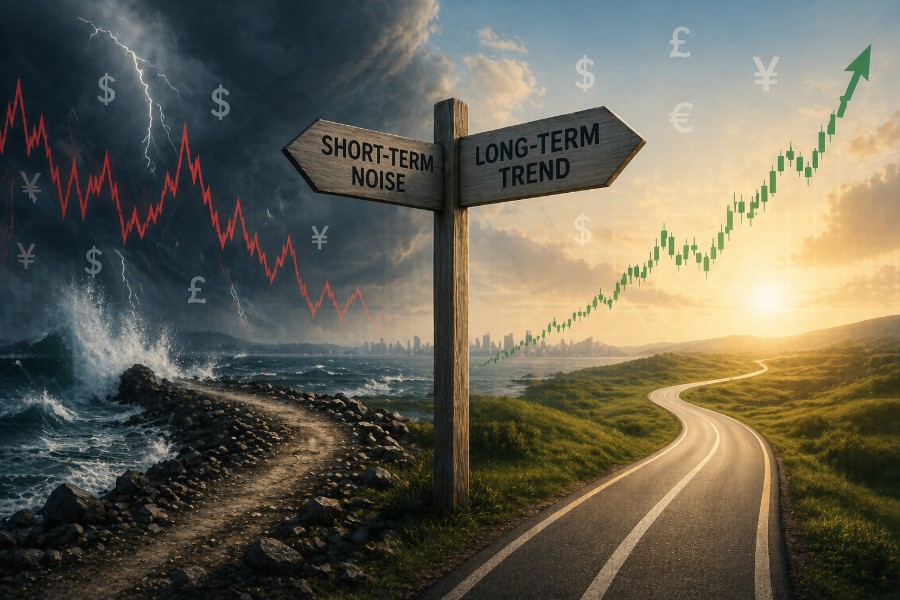
One of the hardest parts about following FX markets is separating what actually matters from what simply feels important in the moment.
Currencies move constantly. Headlines hit the wires every few minutes. Economic data surprises, central bankers speak, geopolitical tensions flare up, and social media immediately turns every 20-pip move into a “major breakout.”
Most of it is noise.
That doesn’t mean short-term price action is irrelevant. Intraday moves absolutely matter for traders, hedgers and positioning flows. But from a broader macro perspective, there’s a significant difference between temporary volatility and a genuine long-term currency trend.
Understanding that distinction can completely change the way someone interprets the market.
The market moves faster than the underlying economy
One of the strange realities of FX is that currencies often react instantly to information that may take months to fully impact the real economy.
Markets are forward-looking.
That means traders aren’t simply reacting to what’s happening today – they’re constantly trying to anticipate:
- where growth is heading,
- where inflation is heading,
- how central banks might respond,
- and how global capital flows could evolve over time.
As a result, short-term FX moves are often driven by:
- positioning squeezes,
- sentiment shifts,
- option expiries,
- liquidity conditions,
- or temporary repricing events.
These can create sharp swings that look meaningful in the moment but ultimately fade once the market recalibrates.
Longer-term trends, however, tend to be driven by something deeper.
Usually some combination of:
- interest rate differentials,
- capital flows,
- relative growth expectations,
- structural inflation trends,
- commodity cycles,
- or broader macroeconomic regimes.
That’s why a currency can rally aggressively for a week while still remaining locked inside a much larger bearish trend that’s been developing for months.
Short-term volatility often feels more important than it really is
This is partly psychological.
Humans naturally focus on what’s immediate and visible. A large daily move grabs attention far more easily than a slow-moving macro trend that’s quietly building in the background.
Financial media amplifies this even further.
Every data release suddenly becomes:
- “critical,”
- “market changing,”
- or “a major turning point.”
In reality, many economic releases only matter because of how they influence the broader macro narrative already driving the market.
For example, if investors are heavily focused on whether central banks will keep rates restrictive, inflation data suddenly becomes extremely important.
Six months later, that same data point may barely move the market at all because the narrative has shifted elsewhere.
The context matters more than the individual release itself.
Why long-term FX trends usually develop slowly
Major currency trends rarely begin with one single event.
More often, they emerge gradually as the market slowly reprices an evolving macro backdrop.
This is one reason why some of the largest FX moves initially feel surprisingly boring.
There’s no dramatic “moment.”
Instead:
- yield differentials slowly widen,
- growth expectations drift apart,
- capital flows gradually adjust,
- and positioning steadily builds.
Then eventually the market reaches a point where momentum accelerates and the trend becomes obvious in hindsight.
By then, much of the move has often already happened.
The U.S. dollar rally through large parts of the post-pandemic cycle was a good example of this. It wasn’t driven by one isolated headline. It was the result of multiple themes reinforcing each other over time:
- relatively stronger U.S. growth,
- higher real yields,
- tighter monetary policy expectations,
- global uncertainty,
- and persistent demand for USD liquidity.
The trend became self-reinforcing.
Noise still matters – but for different reasons
Ignoring short-term price action entirely would also be a mistake.
Short-term volatility provides useful information about:
- market positioning,
- sentiment,
- liquidity conditions,
- and how sensitive the market is to new information.
Sometimes the way a currency reacts to news matters more than the news itself.
If weak economic data fails to push a currency lower, that can tell you positioning may already be heavily bearish.
Likewise, when markets stop reacting positively to “good” news, it can sometimes signal that a trend is becoming exhausted.
This is why experienced macro traders often pay close attention to:
- reaction functions,
- momentum persistence,
- and market behaviour around key levels.
Not just the headlines.
The danger of becoming too reactive
One of the more common mistakes in FX is constantly changing directional views based on every short-term move.
Markets naturally oscillate.
Even the strongest long-term trends experience:
- pullbacks,
- squeezes,
- consolidations,
- and periods of confusion.
If every counter-trend move is interpreted as a full macro reversal, it becomes almost impossible to maintain a coherent framework.
That doesn’t mean analysts should stubbornly ignore changing conditions. Good macro analysis requires flexibility.
But there’s a difference between:
- adapting to genuinely changing fundamentals,
- and emotionally reacting to market noise.
The two are not the same thing.
Final thoughts
FX markets can feel chaotic in the short term because there are constantly multiple forces interacting at once.
But beneath that noise, longer-term currency trends are usually being driven by a relatively small number of dominant macro themes.
The challenge is identifying which forces are temporary and which ones are structural.
That’s rarely obvious in real time.
And honestly, that’s part of what makes FX so difficult.
Short-term volatility will always dominate attention because it’s immediate, emotional and highly visible. But over time, the larger macro trends still tend to matter most.
The traders and analysts who consistently survive in this market are usually the ones capable of filtering out enough noise to keep sight of the bigger picture.
Comments are closed