


If you pulled up EURNZD this month and moved on, I don’t blame you. The pair sits around 1.958 as we head into late July, having drifted a little over the last few weeks and not much more over the last year.
It’s a minor cross, it’s low-vol, and it doesn’t make headlines.
But underneath that flat surface is one of the cleanest fundamental setups in the whole G10 complex right now – two central banks walking in opposite directions, at the same time, with the data backing both of them up.
One is hiking into rising inflation. The other has almost certainly finished and is being nudged toward cuts. That’s the trade. This piece explains why we’re leaning short EURNZD, and just as importantly, what would tell us we’re wrong.
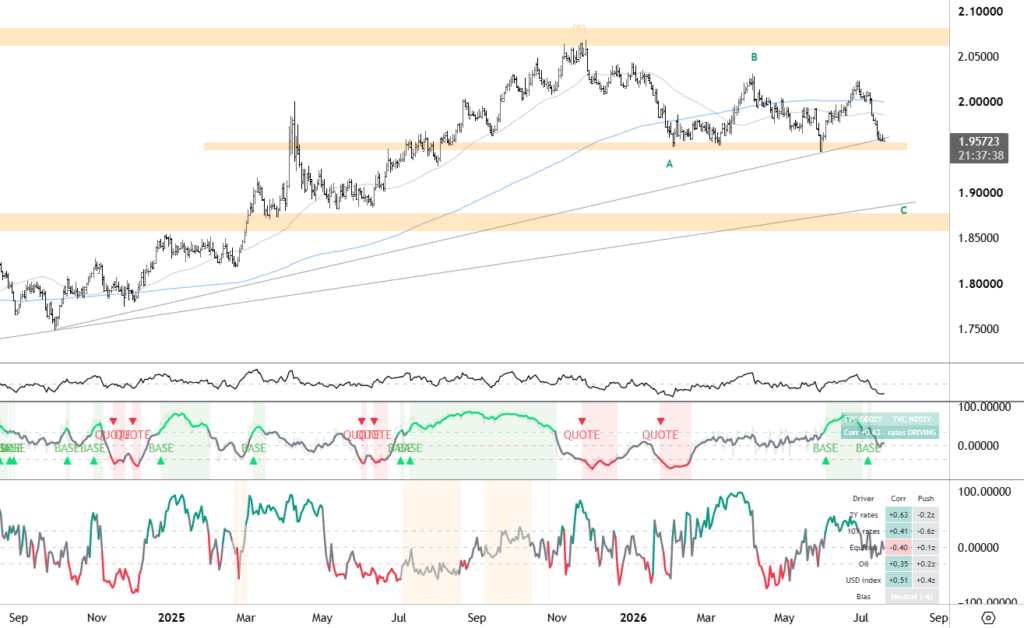
EURNZD has quietly ground lower off its June peak – sitting in the bottom quartile of its 1.928–2.069 yearly range.
Where we stand: bottom of the range, and it’s not random
Start with the lay of the land. EURNZD is trading near 1.958, down roughly 1.5% on the week and around 2% on the month, sitting close to the floor of its 52-week range of about 1.928 to 2.069. Price rolled over from a swing high near 2.02 in late June and has been making lower highs and lower lows since.
That matters because the move isn’t a random wobble in a quiet pair – it lines up almost perfectly with what the fundamentals are saying. When the tape and the macro story point the same way, you pay attention. When they disagree, you wait. Right now, they agree.
The Kiwi side: the RBNZ is the hawk of the G10
Here’s the part that surprised a lot of people. On 8 July the Reserve Bank of New Zealand raised the Official Cash Rate by 25 basis points to 2.50% – its first hike in more than three years. And it didn’t hedge much on what comes next, noting that further increases “appear likely at upcoming meetings,” even while stressing the timing is uncertain.
This isn’t a central bank hiking out of stubbornness. The data is pushing it. Q1 GDP came in at +0.8% quarter-on-quarter – a genuine acceleration, and the third straight quarter of annual growth. The June manufacturing PMI leapt to 59.7, the strongest read in about five years. Business confidence has jumped. And crucially, inflation is turning back up: the RBNZ expects headline inflation to have peaked near 3.9% in the June quarter, and household inflation expectations have climbed with it.
That June quarter CPI lands on 21 July – the single most important number for this trade in the near term. A print near the RBNZ’s own ~3.9% forecast effectively locks in the case for another hike in September, and the market is already pricing better-than-even odds of exactly that. Westpac sees the OCR climbing toward 4% over the next year.
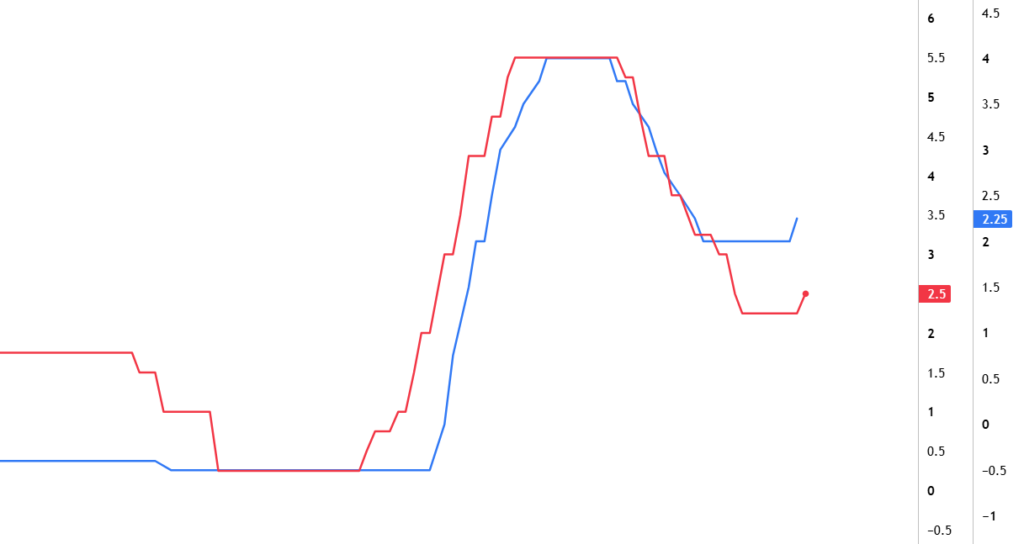
The fork in the road – the RBNZ turning up in July while the ECB flatlines.
The euro side: an ECB that’s probably done
Now flip to the other side of the cross. The European Central Bank delivered its own surprise hike back in June, lifting the deposit rate to 2.25% – but that increasingly looks like a one-and-done. Heading into the 23 July meeting, markets put the odds of a hold at roughly 88%, and the consensus among the big desks (Danske, ING, UBS) is that the ECB does nothing now, hikes once more at most, then starts cutting back toward 2.00% in 2027.
The eurozone data explains the caution. Growth is barely there – Q1 GDP was essentially flat, with France stagnant and the bloc’s composite PMI sitting right on the 50 line that separates expansion from contraction. And inflation is falling, not rising: June headline HICP eased to 2.8%, with core down to 2.4%. That’s a central bank with no reason to keep tightening and every reason to think about the exit.
So put the two together. The short-term rate gap already favours the Kiwi. But the more powerful force is the direction of travel: New Zealand climbing toward 3%-plus, Europe paused and pointing down. That widening forward gap is the engine that drags a cross like EURNZD lower over time.
The opportunity; and where positioning helps
There’s a nice wrinkle in the positioning data. The latest CFTC figures show speculative traders still sitting heavily net-short the New Zealand dollar. That’s contrarian fuel: if the RBNZ keeps delivering and those shorts are forced to cover, the squeeze runs in our direction – NZD up, EURNZD down.
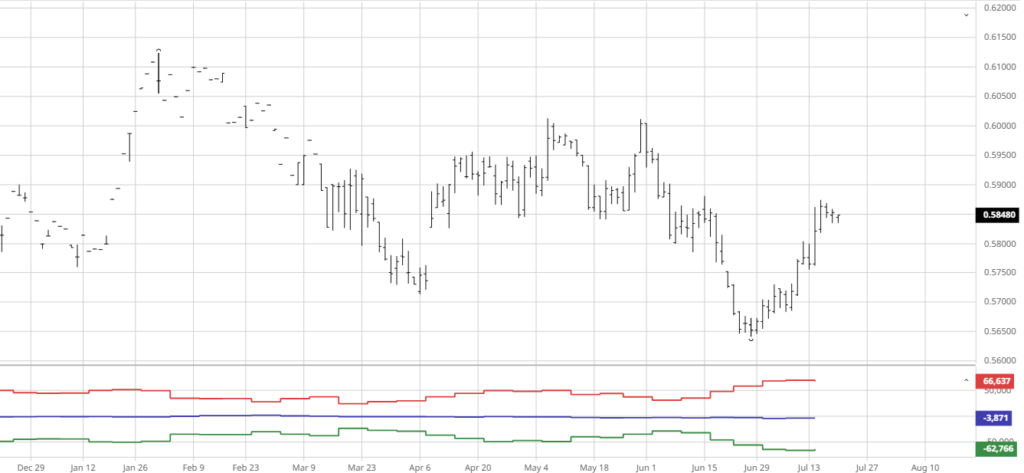
Red = commercials (hedgers), blue = small speculators, green = large speculators.
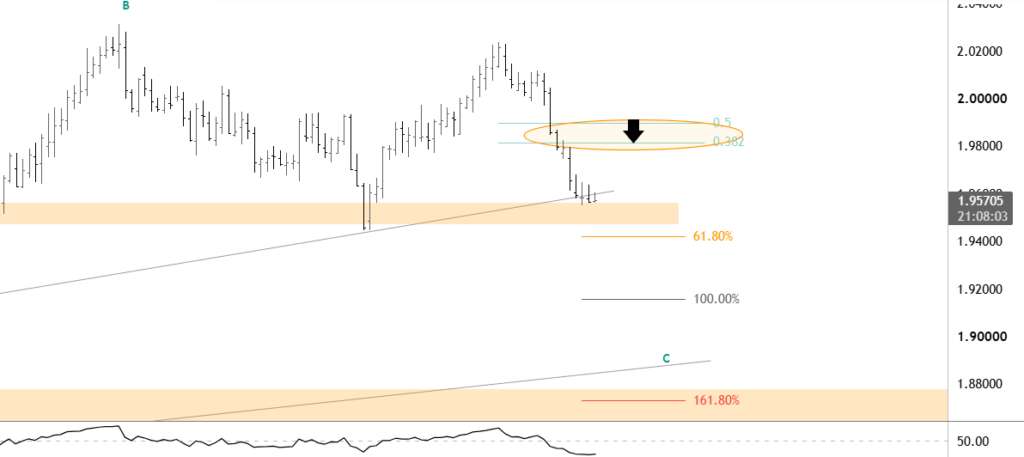
On the levels, we’re leaning short but respecting the chart. Price is oversold on the daily and sitting right on support around 1.958, so chasing it lower here is poor risk-reward. A cleaner entry is on a bounce back toward 1.975-1.990 (Chart 4), targeting 1.945 (61.80% FTE) initially and then the 1.920 range low (100% FTE), with 1.900 (161.80% FTE) at an extreme (Chart 5). A daily close back above 1.9924 is the line in the sand – above there, the near-term bearish structure is gone and we stand aside.
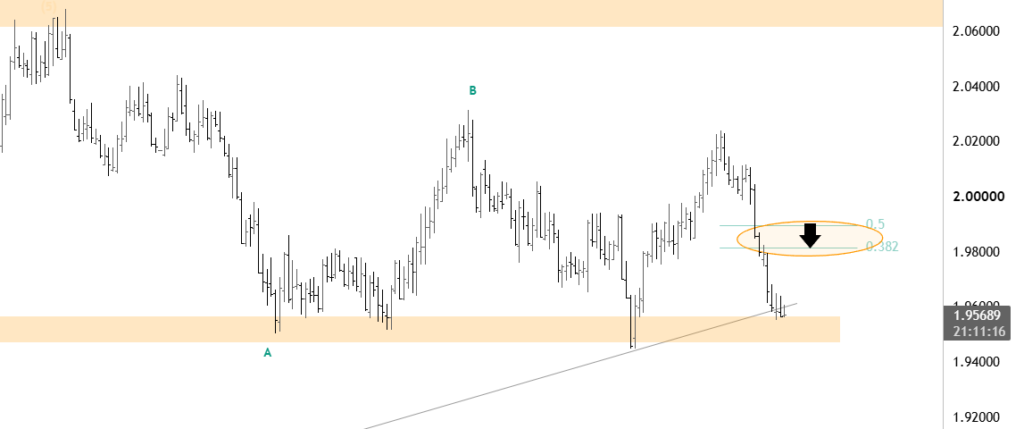
Ideally, we would want to enter short on a retracement to 1.975-1.990.
What would break this
No bias is bulletproof, and this one has two real risks worth naming. First, if that 21 July CPI comes in soft – well under ~3.5% – the September hike case wobbles and the whole divergence narrative loses its edge. Second, the Kiwi is a risk-sensitive, pro-cyclical currency, while the euro behaves as a partial safe haven. A genuine global risk-off shock – another flare-up in the Middle East, say – would bid the euro and sell the Kiwi, and this trade would go straight against us. Softer dairy prices at the latest Global Dairy Trade auction are a smaller headwind to keep half an eye on.
There’s also a subtler trap: markets have a habit of over-pricing how far a central bank will actually hike. If the RBNZ under-delivers versus the 3%-plus path now baked in, the Kiwi gives some back.
Bottom line
Two catalysts, two days apart, both pointing the same way. New Zealand CPI on 21 July should confirm inflation is turning back up and a hawkish RBNZ has more work to do. The ECB on 23 July should confirm a central bank that’s run out of reasons to tighten. Fundamentals, positioning and price action are all leaning in the same direction here – and in a pair this quiet, that alignment is exactly the kind of edge that’s easy to walk straight past.
Sources: RBNZ Monetary Policy Statements and rate decisions; Stats NZ; Eurostat flash HICP releases; ECB Eurosystem staff macroeconomic projections (June 2026); US Bureau of Labor Statistics; market-implied policy pricing via OIS; sell-side commentary from ING, TD Securities, Commerzbank, MUFG and NBC as cited in text.
Disclaimer
The information provided in this article is for general informational and educational purposes only and does not constitute financial, investment or trading advice. The views expressed are the author’s opinions at the time of publication and may change without notice. They do not take into account your personal financial situation, objectives or risk tolerance.
Financial markets involve risk and past performance is not a reliable indicator of future results. Readers should conduct their own research and seek independent financial advice before making any investment or trading decisions.
The Venca Report accepts no liability for any loss or damage arising directly or indirectly from the use of the information contained in this publication.
Comments are closed