

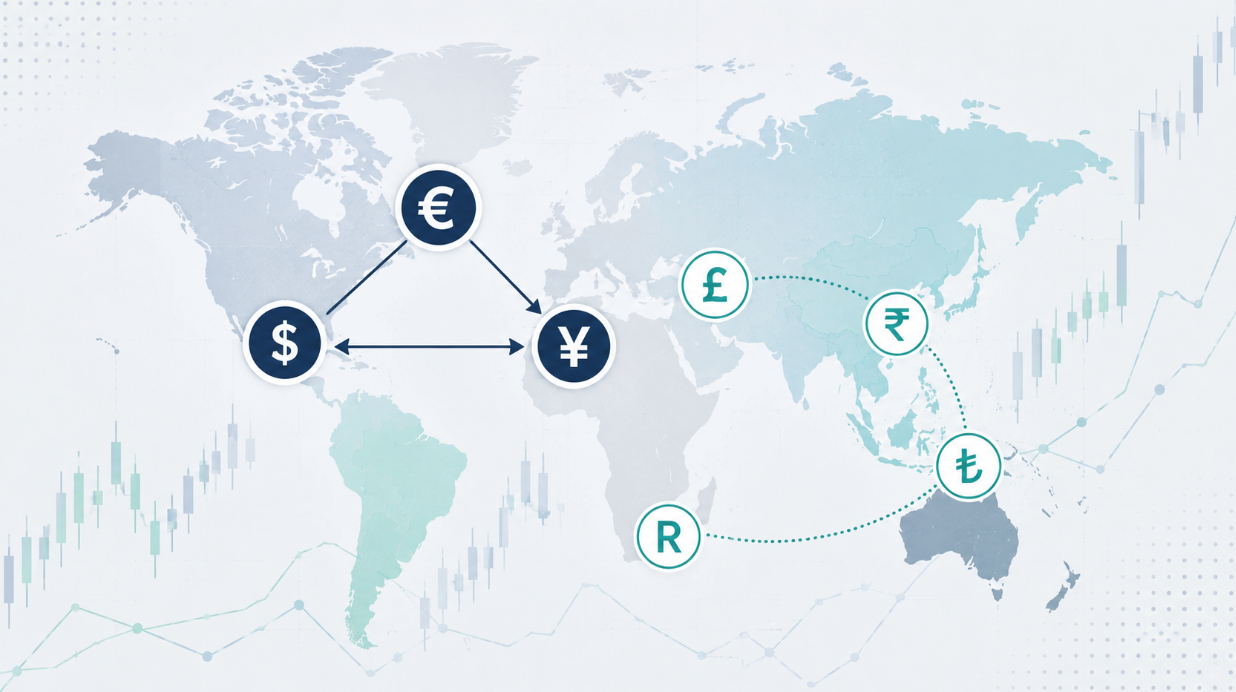
Most forex traders start with the majors. EURUSD, GBPUSD, USDJPY, AUDUSD, NZDUSD – the usual crowd. They are liquid, well-covered, relatively cheap to trade, and easy to follow from a macro point of view.
But after a while, it is natural to start looking elsewhere.
Maybe EURUSD feels too slow.
Maybe USDJPY is crowded.
Maybe you see a huge move in USDTRY, USDMXN or GBPJPY and wonder whether the better opportunities are hiding away from the obvious pairs.
That brings us to a fair question: are FX crosses and exotics actually worth trading?
The honest answer is yes, but not for everyone… and definitely not all the time.
First, what are FX crosses and exotics?
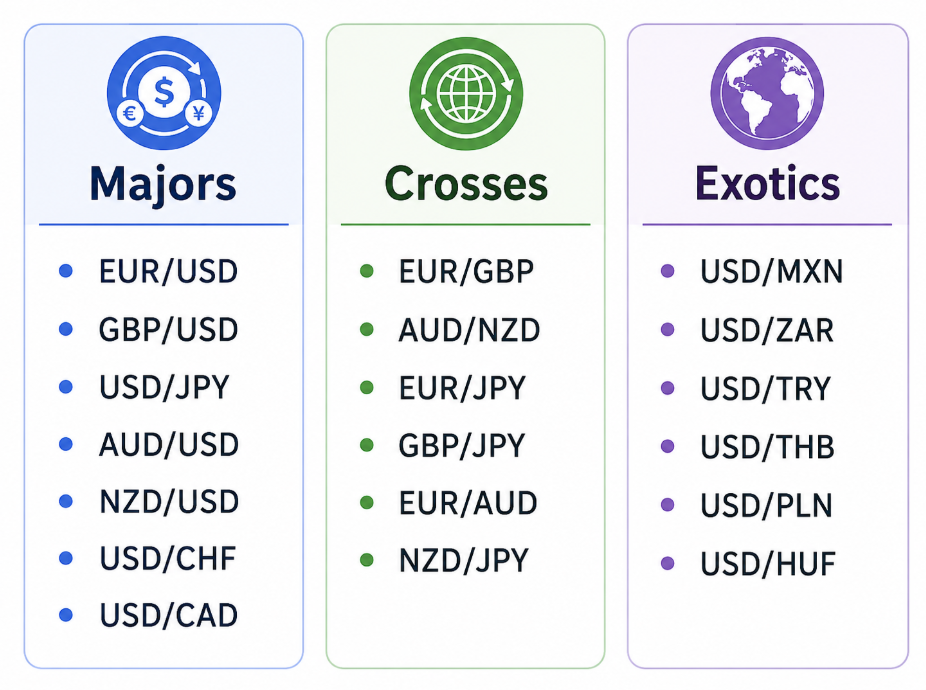
A currency cross is any FX pair that does not include the US dollar.
Examples include:
- EURGBP
- AUDNZD
- EURJPY
- GBPJPY
- AUDJPY
- EURAUD
- NZDCAD
These pairs are still often liquid, especially the larger crosses involving the euro, yen, pound, Aussie, Kiwi or Canadian dollar. But they behave differently from the majors because you are no longer just trading “USD strength” or “USD weakness”. You are trading the relative story between two non-US economies.
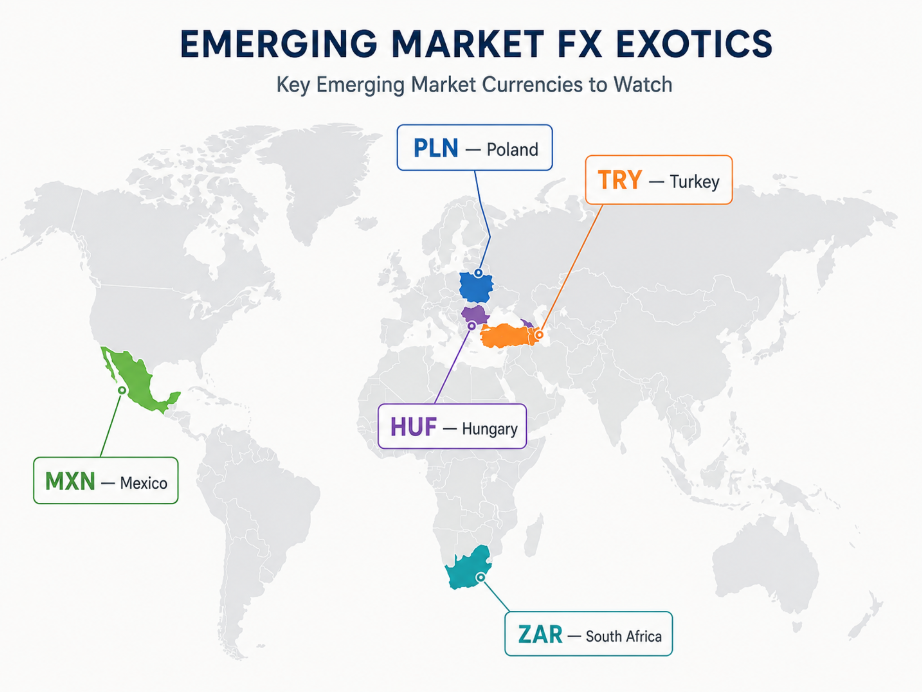
An exotic currency pair usually includes one major currency and one currency from a smaller, less liquid or emerging market economy.
Examples include:
- USDMXN
- USDZAR
- USDTRY
- EURTRY
- USDTHB
- USDPLN
- USDHUF
These can move sharply, but they usually come with wider spreads, higher volatility, less liquidity, and more political or policy risk.
That does not make them bad. It just means they need to be treated differently.
Why traders are drawn to crosses
The best thing about FX crosses is that they can give you a cleaner view of a theme.
For example, say you are bearish on the euro but also bearish on the US dollar. Selling EURUSD might not be the cleanest trade because both sides of the pair are weak. But selling EURCHF, EURGBP or EURAUD might express the view better, depending on what is driving the market.
This is where crosses can be useful. They let you separate one currency story from another.
AUDNZD is a good example. It is not really a “global risk” trade in the same way AUDUSD or NZDUSD can be. It is more about Australia versus New Zealand. Relative interest rates, commodity exposure, central bank expectations, migration trends, housing cycles and growth momentum can all matter.
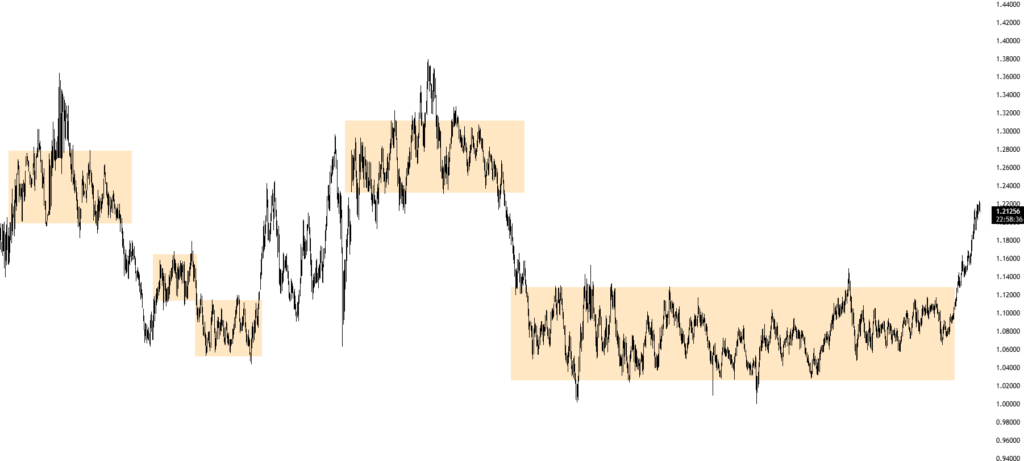
EURGBP is similar. It often comes down to relative UK versus eurozone fundamentals. It can be slow, frustrating and range-bound for long periods, but when the policy or growth gap becomes clear, it can trend well.
The same goes for yen crosses. AUDJPY, NZDJPY and GBPJPY are often treated as risk-sensitive pairs because they combine higher-beta currencies with a funding currency. When global risk appetite is strong, those pairs can rally aggressively. When markets turn defensive, they can fall just as quickly.
So the appeal is obvious. Crosses can offer more specific trade ideas than the majors.
The problem with crosses
The downside is that crosses can be harder to analyse.
With EURUSD, you are mostly looking at the eurozone versus the US. That is already a big enough job. With EURAUD, you need to understand Europe, Australia, China, commodities, global risk appetite, rate expectations and sometimes even the USD indirectly.
This is where a broader macro framework helps. The Macro Dashboard inside The Venca Report is designed to pull those bigger drivers into one place, so the currency view is not based on a chart alone.
That is the part many traders underestimate.
Even though the US dollar is not in the pair, it can still influence the trade. For example, if global markets are moving because of US yields, Fed expectations or risk sentiment, crosses can still be dragged around by broader USD-driven flows.
This is why crosses are not always “cleaner”. Sometimes they are cleaner. Other times, they are just more complicated.
There is also the issue of spread and execution. Most major crosses are still tradable for retail traders, but they usually have wider spreads than EURUSD or USDJPY. That may not matter much if you are holding a position for days or weeks, but it matters a lot if you are scalping or trading short timeframes.
For longer-term traders, the spread is less of a problem. But the bigger challenge is interpretation. Crosses can move in strange ways if both currencies are being pushed by similar forces.
For example, AUD and NZD often move together because both are tied to global risk and China sentiment. That means AUDNZD can grind sideways for long periods before finally breaking. The trade may be fundamentally interesting, but it can still be painfully slow.
Where crosses can add real value
Crosses are most useful when there is a clear relative divergence.
That could be:
- One central bank turning more hawkish while another becomes more dovish
- One economy holding up better than another
- One currency benefiting from commodity strength while another does not
- One country facing political stress while another looks stable
- One side having better yield support
- One side being overextended technically while the other has room to recover
The key word is relative.
You are not just asking, “Is the Australian dollar strong?”
That is also why our FX Forecasts are built around relative currency views, not just whether one currency looks “strong” or “weak” in isolation.
You are asking, “Is the Australian dollar likely to outperform the New Zealand dollar, euro, yen or Canadian dollar?”
That is a better question, but it is also a harder one.
This is why crosses often suit traders who already have a decent macro framework. If you understand rates, inflation, growth, risk sentiment and commodity exposure, crosses can be very useful. If you are trading purely from chart patterns, they can still work, but you need to be careful with liquidity and volatility.
What about exotics?
Exotics are a different animal.
They can look tempting because the moves are often much larger. A major pair might move 1% or 2% in a week. An exotic can move far more than that, especially during a policy shock, election, crisis or central bank surprise.
That can make them look like easy money.
They are not.
Exotics often come with much wider spreads, thinner liquidity, sharper gaps and higher financing costs. They can also be heavily influenced by local politics, capital controls, central bank intervention, inflation shocks, debt concerns and sudden changes in investor confidence.
For example, USDTRY or USDZAR can produce enormous moves, but they are not the same as trading EURUSD. The risk profile is completely different. You are dealing with currencies where policy credibility, inflation expectations and political headlines can matter just as much as traditional technical levels.
That does not mean exotics should be avoided completely. Some traders specialize in them very successfully. But they require more patience, wider stops, smaller position sizes and a stronger understanding of local risks.
For most retail traders, exotics are better treated as occasional opportunities rather than everyday trading instruments.
The hidden issue: carry
One reason traders like exotics is carry.
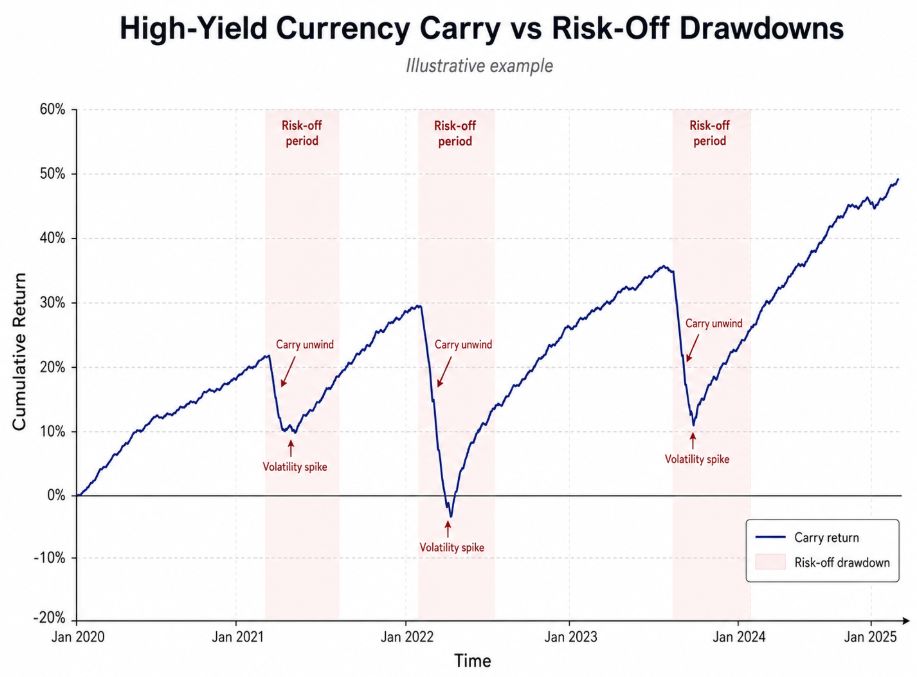
If one currency has a much higher interest rate than another, holding the position can produce positive overnight financing. This is often called the carry trade.
In simple terms, traders borrow in a low-yielding currency and buy a higher-yielding currency. When markets are calm and investors are comfortable taking risk, carry trades can perform very well.
But carry is not free money!
High interest rates usually exist for a reason. They may reflect high inflation, political risk, weak currency credibility or a central bank trying to defend confidence. That means the positive carry can be wiped out quickly if the exchange rate moves against you.
This is one of the classic traps in exotics. The yield looks attractive, but the currency risk is much larger than expected.
The better way to think about carry is this: it can support a trade, but it should not be the only reason for taking one.
Crosses versus exotics: which are better?
For most traders, crosses are more useful than exotics.
They give you more flexibility than majors without introducing the same level of liquidity, spread and political risk that comes with many exotic pairs.
A well-chosen cross can be an excellent way to express a macro view. For example:
- Long AUDJPY if global risk appetite is improving and the yen is under pressure
- Short EURGBP if UK data and rate expectations are improving relative to Europe
- Long AUDNZD if Australian growth and rate support look stronger than New Zealand
- Short EURCHF if eurozone risks are rising and safe-haven demand is building
Those are not trade recommendations, but they show how crosses can be used to express a cleaner view.
Exotics, on the other hand, are usually better for traders who understand emerging markets, can handle wider stops, and are comfortable with sudden volatility.
When should you avoid crosses and exotics?
You should be cautious when the pair has poor liquidity, the spread is too wide, or you do not understand what is driving both currencies.
That last point is important.
A lot of traders will buy or sell a cross because the chart looks good, without thinking about the underlying drivers. That might work sometimes, but it becomes dangerous when the pair starts moving for reasons that are not obvious from the chart alone.
You should also be careful around major event risk. Central bank meetings, elections, inflation releases, employment data and geopolitical headlines can all hit crosses and exotics hard.
With exotics, the risk is even greater because gaps can be larger and liquidity can disappear faster.
The basic rule is simple: the less liquid the pair, the smaller the position should be.
Are FX crosses and exotics worth it?
Yes – but only when they give you something the majors do not.
That is the real test.
A cross is worth trading if it gives you a cleaner expression of a relative macro view. An exotic is worth trading if the opportunity is strong enough to justify the extra spread, volatility, liquidity risk and local-market complexity.
But they are not automatically better just because they move more.
More movement can mean more opportunity, but it can also mean more noise, more slippage and more ways to get caught on the wrong side of a headline.
For most traders, the sweet spot is probably the major crosses: EURGBP, AUDNZD, EURJPY, GBPJPY, AUDJPY, EURAUD and NZDJPY. These pairs are liquid enough to trade, but different enough from the majors to offer interesting opportunities.
We cover these sorts of themes regularly in the Analysis & Research section, especially when a cross starts to show a clearer macro or technical setup.
Exotics should be approached more selectively. They can be useful, especially for macro traders, but they need proper risk management and a clear understanding of what is actually driving the currency.
The big takeaway is this: do not trade a cross or exotic just because it looks exciting. Trade it because it gives you a better expression of your view.
That is where the value is.
Comments are closed