

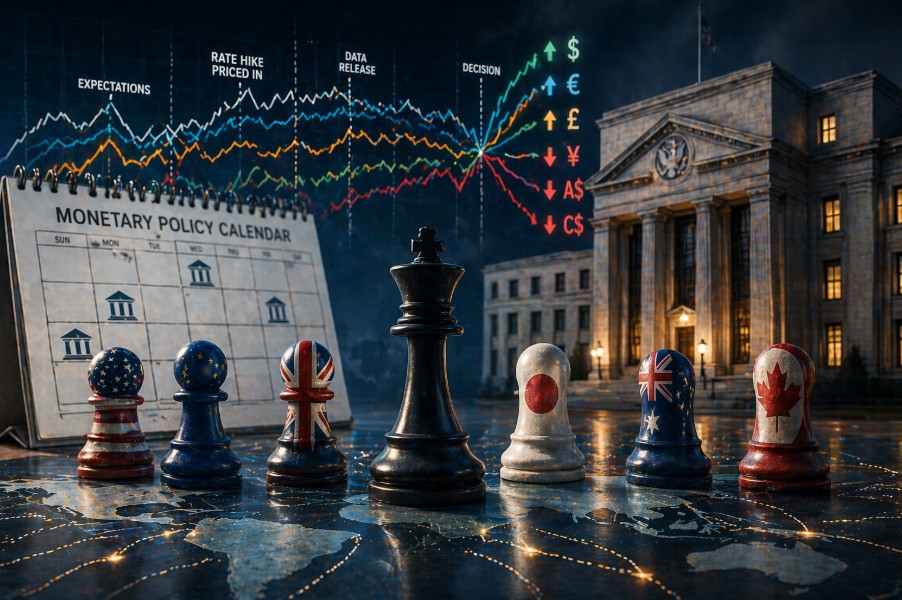
One of the more confusing aspects of FX markets for newer macro traders is watching a central bank deliver exactly what markets expected… only for the currency to barely move afterwards.
Or sometimes even reverse direction entirely.
At first glance, that seems irrational.
Surely a rate hike should strengthen a currency?
Surely a rate cut should weaken it?
Sometimes they do.
But by the time the actual decision arrives, FX markets have often already spent weeks – or even months – pricing the move beforehand.
In reality, currencies frequently move before central banks act, not after.
And understanding that dynamic is one of the more important shifts people make when they move from simply following headlines to genuinely understanding macro markets.
Markets are constantly trying to price the future
FX is fundamentally a forward-looking market.
Currencies don’t just react to where interest rates currently are. They react to where markets think rates are heading in the future.
That means traders are constantly repricing expectations around:
- inflation,
- economic growth,
- labour markets,
- financial stability,
- and central bank behaviour.
By the time a central bank finally delivers a rate decision, markets have usually already built a substantial amount of that expectation into pricing.
This is why phrases like:
- “priced in,”
- “fully discounted,”
- or “the market is expecting…”
matter so much in macro trading.
The actual policy decision is often less important than whether the central bank validates or challenges existing expectations.
Expectations matter more than the current rate itself
This is a subtle but important distinction.
Imagine two countries:
- Country A has rates at 5% but markets expect cuts soon,
- Country B has rates at 3% but markets expect hikes over the next year.
Despite having lower current rates, Country B’s currency may actually strengthen because markets care about the future path of policy, not just the present level.
FX markets are constantly repricing the expected direction of interest rate differentials.
That repricing can begin long before any official move happens.
In many cases, the currency trend starts months ahead of the first rate hike or cut.
Central bank communication becomes a market driver itself
This is why modern central banking is as much about communication as policy action.
Markets obsess over:
- speeches,
- press conferences,
- meeting minutes,
- inflation forecasts,
- and subtle wording changes.
Not because traders enjoy overanalysing every sentence, but because small shifts in communication can materially alter future policy expectations.
A single phrase change can sometimes move FX markets more aggressively than the actual rate decision itself.
For example:
- a central bank hiking rates while sounding cautious about future tightening may weaken the currency,
- while a central bank leaving rates unchanged but signalling future hikes may strengthen it.
Again, markets are trading expectations.
Not simply reacting mechanically to today’s decision.
Yield differentials remain one of the core drivers
At a macro level, currencies are heavily influenced by relative yield expectations between economies.
This is often simplified as:
Currency Strength∝Expected Interest Rate Differential
Of course, real markets are more complicated than that.
But broadly speaking:
- if markets expect one central bank to remain tighter for longer,
- while another begins easing,
- yield differentials can widen in favour of the first currency.
That tends to attract capital flows over time.
This dynamic became particularly important during the post-pandemic tightening cycle, where markets constantly repriced:
- how high rates would go,
- how long they would stay restrictive,
- and which economies were most vulnerable to slower growth.
Those expectations drove enormous FX volatility well before many central banks had fully completed their tightening cycles.
Sometimes the market reacts more to what didn’t happen
This is where central bank meetings become especially interesting.
Often the biggest market moves occur not because policymakers did something shocking, but because they failed to deliver what markets had aggressively priced beforehand.
For example:
- if traders expect extremely hawkish guidance and receive something merely “less hawkish,” the currency may fall,
- even if rates were still increased.
Likewise:
- a central bank widely expected to cut aggressively may trigger a currency rally simply by sounding slightly more cautious than feared.
The reaction depends on the gap between:
- market expectations,
- and the reality delivered.
That gap is what markets constantly trade.
Why currencies can disconnect from economic data
This also explains why FX markets sometimes appear disconnected from domestic economic releases.
If markets believe a central bank is already near the end of its tightening cycle, even strong economic data may struggle to support the currency because traders are already looking ahead toward future easing.
Likewise, weak data can occasionally be ignored if markets think policymakers will remain restrictive regardless.
Everything flows back into expectations around future policy paths.
That’s the framework tying much of macro trading together.
Final thoughts
Central banks still matter enormously in FX markets.
But increasingly, it’s not the actual rate decision itself driving currencies – it’s the evolving expectations surrounding where policy may head next.
That’s why:
- speeches matter,
- guidance matters,
- inflation projections matter,
- and subtle communication shifts matter.
Markets are constantly trying to stay one step ahead.
And in FX, by the time the headline decision finally arrives, the bigger move has often already started weeks earlier.
Understanding that doesn’t make central bank trading easy.
But it does make the market behaviour feel far less random.
Comments are closed